


Professional sports betting is based on an analytical approach, not on one-time intuitive decisions. Each bet is viewed as a financial decision with calculated risk, expected profitability and bankroll control. The player's task is not to guess the outcome of one match, but to build a long-term strategy that gives positive results over distance and accounts for all associated costs and risks.
A professional perceives a bet as an investment. What's important is not only whether a specific event "hits," but what mathematical expectation and potential profitability (ROI) a series of such bets gives over a long distance. For him, one loss is not critical if the entire strategy remains positive.
The key goal is positive ROI in the long term, not quick earnings in an evening. To calculate real profitability, all expenses are considered: commissions for deposits and withdrawals, currency conversion, possible bonus wagering, taxes.
Separately important is accounting for the risk of account blocking or cutting. Aggressive play on surebets, obvious value betting patterns, using the same markets in several bookmakers increases the probability of restrictions. Therefore, the strategy must be adapted to bookmaker policies and include a plan for working with limits.
Value Betting (bets with "edge") is playing only on those outcomes where the event probability is higher than that implied by the bookmaker's odds. Mathematical expectation formula:
EV = p·k − 1, where p is your assessment of event probability, k is the bookmaker's odds. If EV > 0, the bet is considered value.
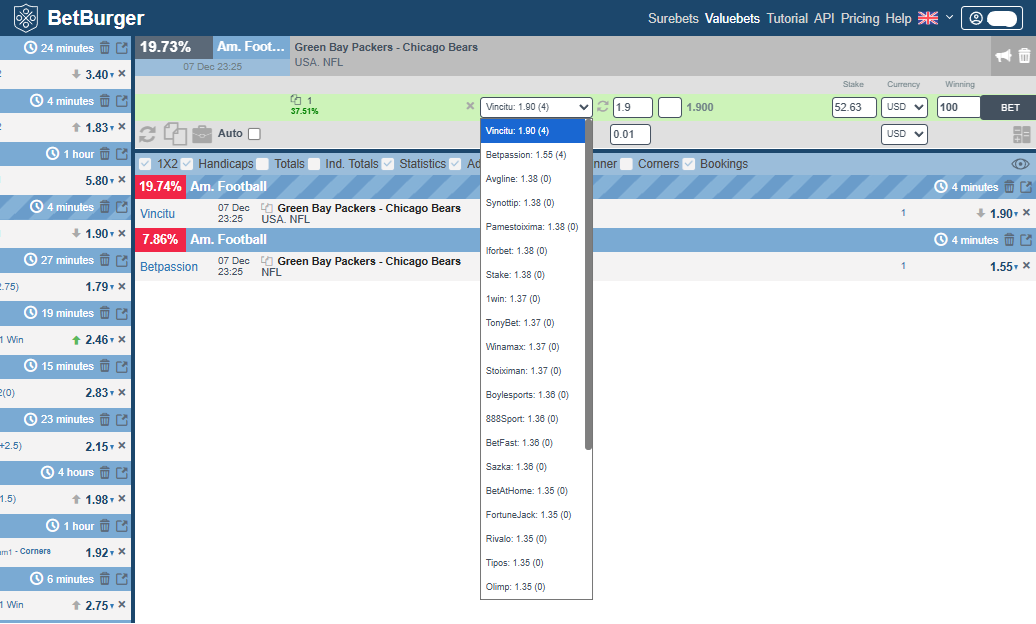
Specific example of NFL match Green Bay Packers — Chicago Bears
One bookmaker gives odds of 1.90 on Packers win, while many other bookmakers keep the line around 1.35-1.55. BetBurger's algorithm estimates the real probability of this outcome approximately as p ≈ 0.63 (63%).
Substituting into the formula:
EV = 0.63 × 1.90 − 1 ≈ 1.197 − 1 = +0.197, that is about +19.7%.
This is exactly why in the upper left corner of the interface for this outcome, value of about 19.73% is displayed — this is an example of classic value bet, when real probability (by model) is noticeably higher than probability "embedded" in bookmaker's odds.
Surebets (betting arbitrage) is a strategy where you bet on all possible outcomes of one event at different bookmakers so as to get profit regardless of match result. Surebet condition for two outcomes:
1/k₁ + 1/k₂ < 1, where k₁ and k₂ are odds at different bookmakers.
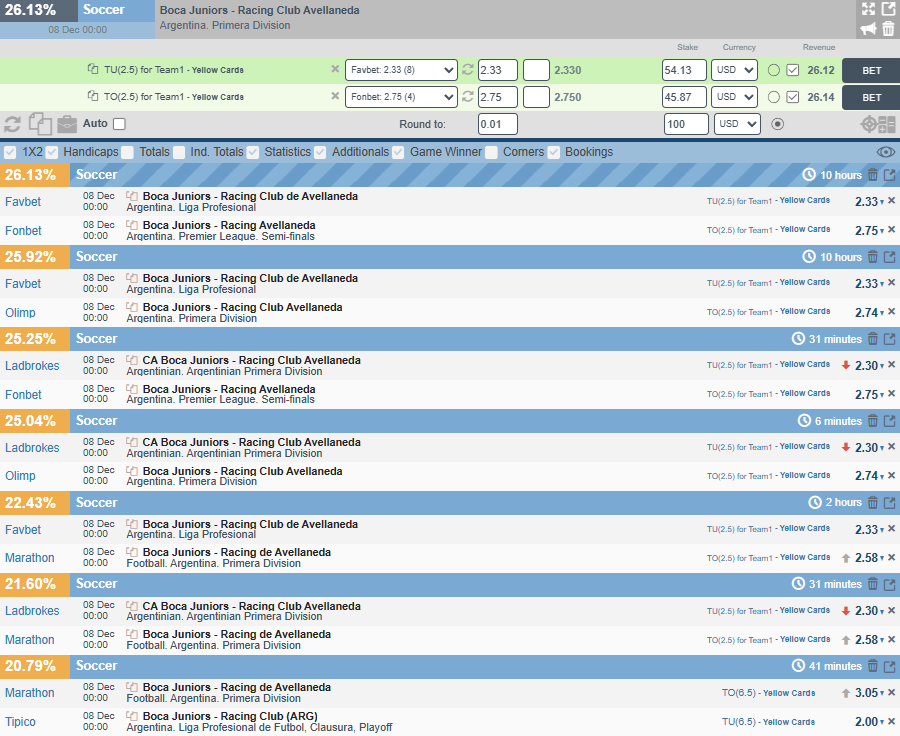
Specific example from BetBurger (match Boca Juniors — Racing Club)
On the market "team 1 yellow cards total over/under 2.5" Bookmaker 1 gives odds k₁ = 2.33, and Bookmaker 2 — k₂ = 2.75 on opposite outcome.
Checking:
1/2.33 + 1/2.75 ≈ 0.79 < 1 — there's an arbitrage situation.
With total bankroll of $100, BetBurger calculates bet amounts:
If first bet wins: 54.13 × 2.33 ≈ $126.13.
If second: 45.87 × 2.75 ≈ $126.14.
In both cases profit is approximately $26 or about 26.1% of bankroll — this is classic surebet.
There are two approaches to finding favorable odds.
Manual option. The player himself compares lines of several bookmakers, analyzes statistics, uses simple calculators and tables. Method is suitable for learning and understanding logic, but very time-consuming and practically powerless in Live, where odds change every second.
Automatic option. Using specialized software that scans lines of dozens of bookmakers in real time, calculates EV, finds surebets and filters events by specified parameters. This approach allows processing thousands of markets per hour and is suitable for professional play. A bright example is BetBurger service.

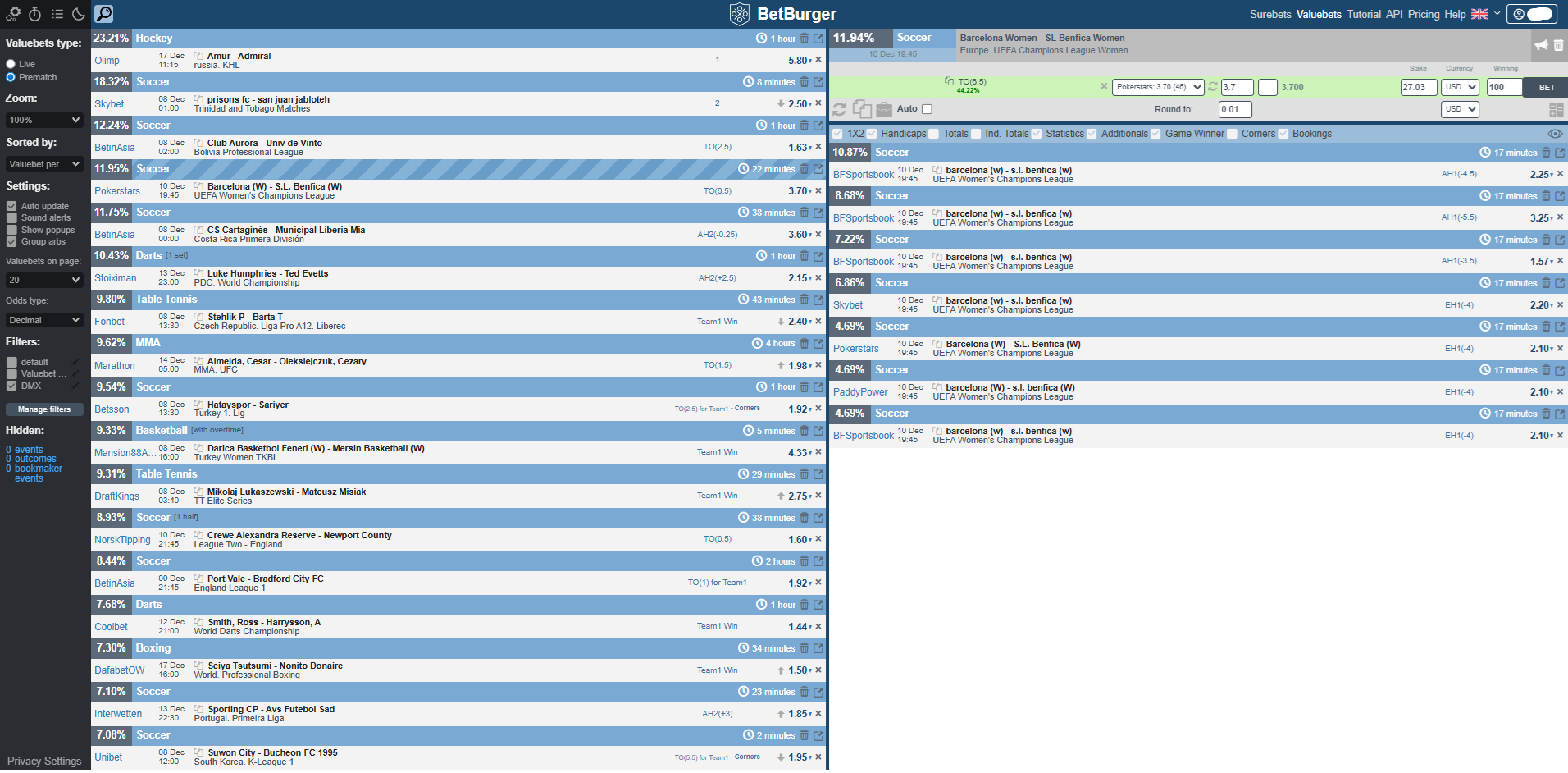
BetBurger is a professional scanner for value bets and surebets that works with a large number of bookmakers and sports. The service collects odds in real time, recalculates outcome probabilities, searches for arbitrage situations and value positions, showing the user only those events where mathematical advantage exists.
For a professional player, BetBurger solves several tasks at once: saves time on line monitoring, reduces risk of missing favorable odds and helps systematically implement Value Betting and Surebets strategies. Flexible filters by bookmakers, sports, margin size and EV allow customizing output for specific playing style and bankroll.
Before starting work, it's important to prepare infrastructure:
Next step is analyzing lines of several bookmakers (and their clones). Need to determine where odds edges most often appear and on which markets it's most convenient to implement your strategy. Most often for Value Betting and Surebets, 1X2 markets, handicaps and totals in popular leagues are used, where there's sufficiently high liquidity and acceptable limits.
At the start, it's important not to chase maximum ROI. First a strategy is chosen — Value Betting or Surebets — and testing is conducted on small bets. Better to use popular championships and standard markets where there are fewer line errors and security services react more calmly. Test period results are recorded, ROI and real profitability are calculated accounting for commissions.
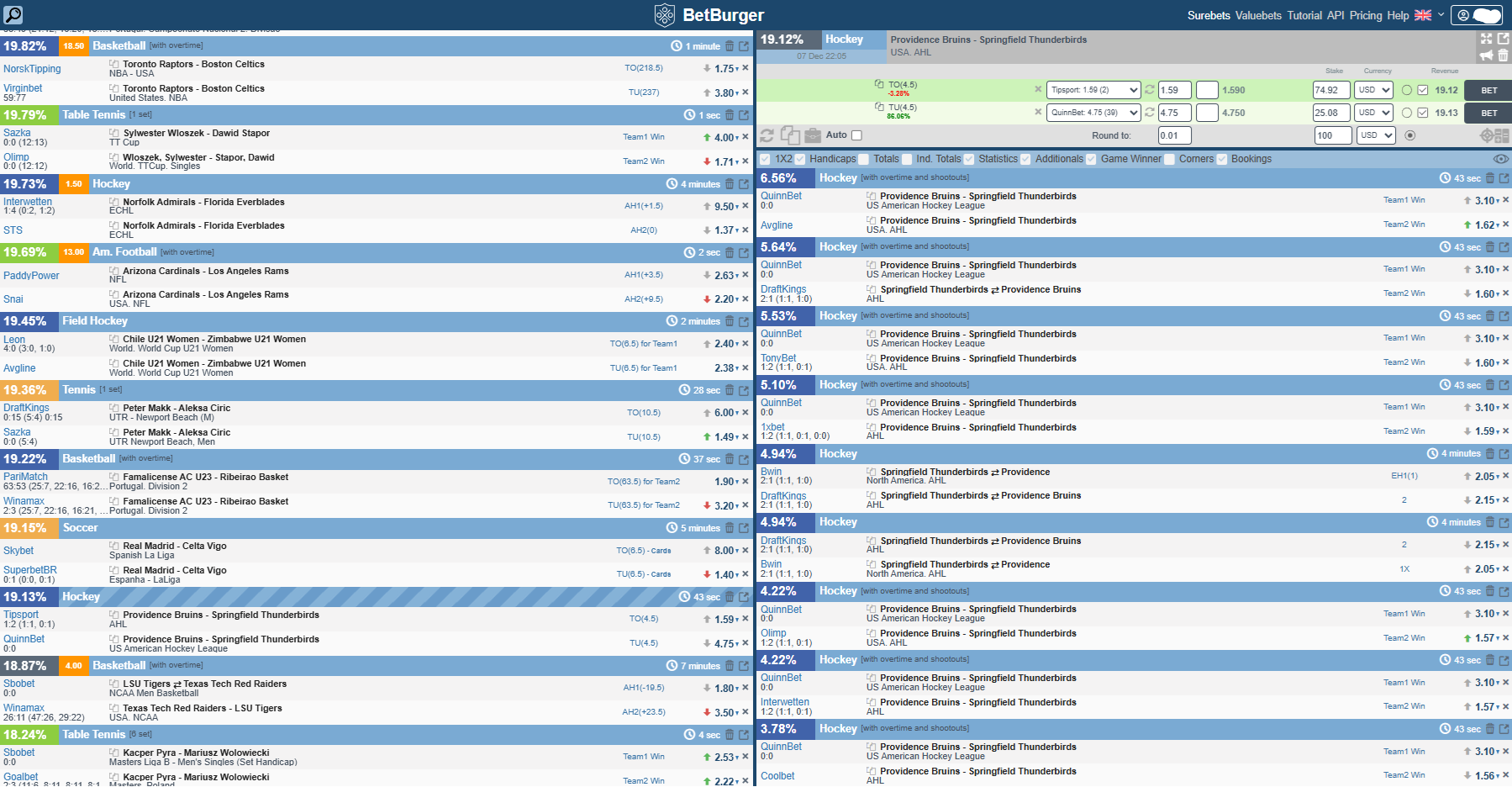
If you plan to play Live, strategy needs to be tested separately. Odds in real-time mode change much faster, risk of outdated quotes and bet entry errors increases. A professional develops his own algorithm: at what minutes and markets he works, what delays he accounts for, what leagues he avoids. Here BetBurger helps find surebets and value positions in Live, but discipline and reaction speed remain critically important.
When you've mastered the bookmaker and BetBurger interface, you can move to full-format play. When making a bet, it's important to:
Each operation is recorded in bet journal: date, bookmaker, market, odds, bet size, result. This allows controlling strategy and timely correcting it.
With systematic play on surebets or obvious value pattern, bookmaker can identify an "arbitrageur" and reduce account limits. As a result, maximum bet size decreases to symbolic amounts, and sometimes account is completely blocked. This is a working risk of any arbitrage and value strategy that needs to be considered in advance.
If you caught outdated odds, there's high probability that bet will be calculated at less favorable odds or simply lose. This is especially critical in Live, where line changes every second. Therefore, high data update speed in the service and quick player reaction when placing bet are important.
Sometimes bookmaker makes obvious error in line and subsequently cancels such bets. In this case surebet "breaks": one leg returns or is cancelled, second remains in play and can lead to loss. A professional tries to avoid too "anomalous" odds and understands risk of working with obviously erroneous lines.
To learn to make bets professionally, it's not enough to simply "feel sports." Clear strategy (Value Betting or Surebets), discipline, accounting for all expenses and understanding of risks, including limits and line errors are needed.
Automation services like BetBurger allow detecting surebets and value bets in odds flows from dozens of bookmakers and turning theory into practice. Combination of own well-thought-out strategy, competent bankroll management and using BetBurger gives a chance to systematically earn over distance, but doesn't cancel the fact that sports betting remains high-risk activity, and you should play only with money you're ready to lose.
 0
0
 0
0