


Modern betting has long ceased to be an activity where opening a bookmaker's website and manually browsing lines is enough. The market has become fast, competitive and technologically saturated. Where attentiveness and a bit of luck used to suffice, today the winner is whoever has automated the process and works with data in real time.
This is exactly where API comes into play — a programming interface that allows receiving current odds, finding arbitrage situations and tracking line movements automatically, without any manual labor. For a developer, arbitrageur or trader, this is not just convenience — it's a fundamental competitive advantage.
API (Application Programming Interface) is essentially a "socket" through which your program connects to an external data source and receives the needed information in structured form. In the context of betting, this means the following: instead of opening a browser and manually checking what odds different bookmakers offer on a team's victory, your script or bot makes a request to the API and within fractions of a second receives a ready response — with odds, markets, event start time and all associated information.
This fundamentally changes the speed and scale of work. Where a person browses a dozen events in an hour, an API integration processes thousands of positions per minute.
Many people start with parsing — writing scripts that scrape bookmaker pages and extract odds from HTML markup. This works, but is an extremely unreliable approach. Any change in a website's layout — and the parser stops working. Bookmakers actively block such requests, change page structure and use dynamic JavaScript loading. As a result, developers spend most of their time not on product development but on "fixing" the parser after each update.
API solves this problem fundamentally. You get a stable, documented interface specifically created for programmatic data consumption. No HTML, no unstable markup — just clean structured JSON with the needed fields. Plus — official access, meaning no IP blocks and no captcha bypassing.
Manual monitoring, in turn, simply doesn't hold up to comparison — especially in the context of Live, where odds change every few seconds. Human reaction speed physically cannot keep up with the market here.
A good bookmaker odds API is not just a stream of numbers. It's a structured dataset that covers the entire lifecycle of an event: from its appearance in the line to the moment it closes.
Prematch refers to odds on events that haven't started yet. There's time for analysis here, data is plentiful and relatively stable. Live is a fundamentally different story: the line updates in real time, odds "live" for seconds, and the value of data directly depends on delivery speed. Therefore a well-designed API must separate these two streams and ensure minimal latency specifically in live mode.
Beyond the odds themselves, a fully-featured API delivers:
If you're building anything related to odds data — API is your foundation. Independently parsing hundreds of bookmakers in real time is a task that requires months of work and continuous maintenance. A ready-made API closes this question from day one.
The range of possible applications is wide:
In all these cases, API saves thousands of development hours and makes the product significantly more reliable.
For those who live on the difference in odds between bookmakers, API means transitioning from a craft to an industry. Manual surebet searching has a hard scaling ceiling: a person physically cannot simultaneously monitor hundreds of bookmakers in live mode.
With API the picture changes radically. The system itself receives a stream of ready arbitrage situations, filters them by specified parameters — ROI, sport type, specific bookmakers, odds range — and passes them to the execution layer. The result is a multiple increase in the number of processed situations without increasing manual labor.
Additionally, API allows building proper accounting: every deal is recorded automatically, statistics accumulate, and you always see the real effectiveness of your strategy.
At this level, API becomes part of serious infrastructure. The conversation is not about individual bets, but about a systematic deal flow with strict risk control.
Odds API integrates into broader systems: bankroll management across accounts at different bookmakers, automatic calculation of optimal bet size using Kelly or fixed stake, integration with payment gateways and wallets for automatic deposits and withdrawals. For syndicates, the ability to run multiple system instances in parallel is also important — a good API supports this through high throughput capacity.
A surebet is a situation where odds from multiple bookmakers on all outcomes of one event collectively create a mathematical advantage: by betting on each outcome at different bookmakers, you guarantee profit regardless of the result.
For finding surebets via API, the algorithm is straightforward: the request returns ready arbitrage situations with already calculated ROI, indicating specific bookmakers and markets. All that remains is applying the needed filters and passing situations to execution. The key requirement for an API here is minimal latency, especially in live: surebets live for seconds, and if data is delayed, the opportunity window closes before you can react.
A valuebet is a bet where the real probability of an outcome is higher than what the bookmaker's odds imply. In other words, the bookmaker "made a mistake" in your favor — and you can capitalize on that.
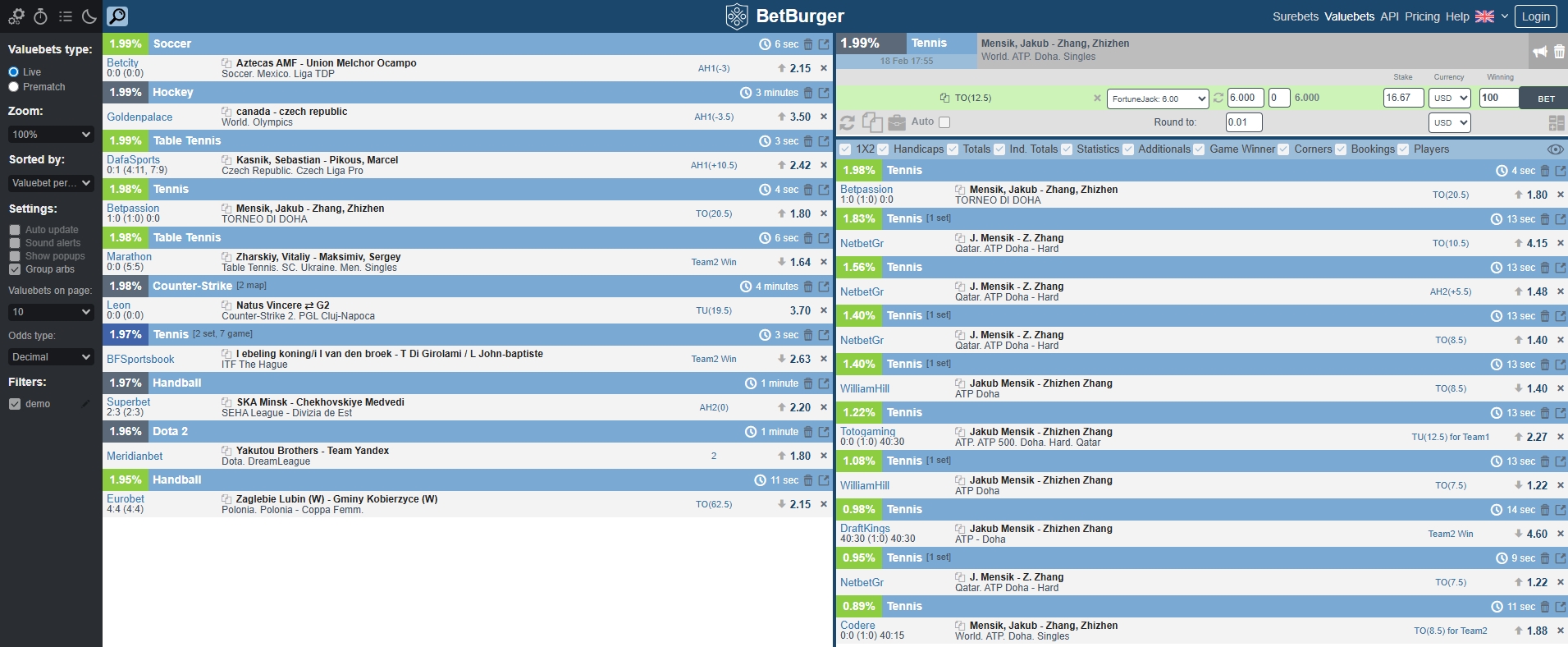
API for finding value works differently than for surebets: here the system compares a specific bookmaker's odds against a reference line — typically sharp bookmakers like Pinnacle, which accept professional bettors and set the "fair" market price. If the odds are noticeably above the reference — this is a potential value position. The API delivers such situations already filtered, with the deviation from the market calculated.
The more bookmakers covered — the higher the chance of finding a discrepancy. But what matters is not just quantity but quality: data currency, correct event matching between different bookmakers, minimal "stale" surebets where odds have already changed or the line is closed. A good API solution ensures high matching accuracy and filters outdated situations before they reach you.
For prematch, update frequency is critical — odds change more slowly but volumes are high. For live — latency must be minimal, ideally a few seconds from the moment of change at the bookmaker to appearing in your application. It's also important to know the requests per minute limit (rate limit) — this determines how intensively you can work with the data stream.
JSON is today's de facto standard for REST APIs — it parses easily in any language, is human-readable and well-suited for stream processing. XML appears in older solutions and adds unnecessary overhead. A good API should have clear documentation, request examples and preferably an interactive sandbox for testing directly in the browser — without the need to write code "blind."
Without the ability to filter data, the information stream quickly turns into noise. Essential parameters include: sport type, specific bookmakers, country and league, market type, time to event start, minimum ROI, odds range. The more precisely a request can be configured — the less unnecessary data your system processes and the faster it responds to needed situations.
BetBurger Odds API is one of the oldest and most mature services in the arbitrage betting niche, operating since 2013. Over this time the platform has evolved from a web surebet scanner into a full-fledged infrastructure with API access, used by both individual developers and professional teams.
Read more: What is API and how to deal with it
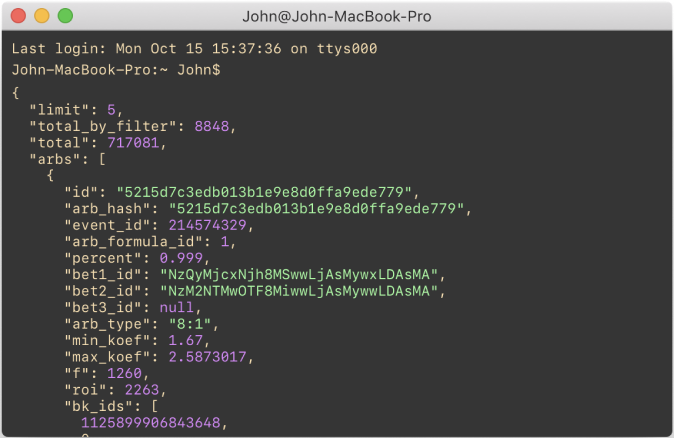
Surebets and valuebets in prematch and live in JSON format. Both signal types are available through a single API, without needing to connect different sources. The response format is standard JSON, ready for processing in any stack.
Coverage: 65+ bookmakers (230+ with clones) and 30+ sports. This is one of the broadest coverages on the market. Bookmaker clones — subsidiary brands and regional versions of major bookmakers — substantially expand the number of unique odds sources and increase the number of found situations.
Performance: up to 30 results per request and up to 1800 results per minute. 30 results per request is 50% more than the web version. 1800 results per minute provides high throughput even with intensive work on the live stream.
Rich filtering and sorting. Filtering is available by sport, bookmaker, country, tournament, start time, ROI and a number of other parameters. This allows precisely configuring the data stream and receiving only relevant situations.
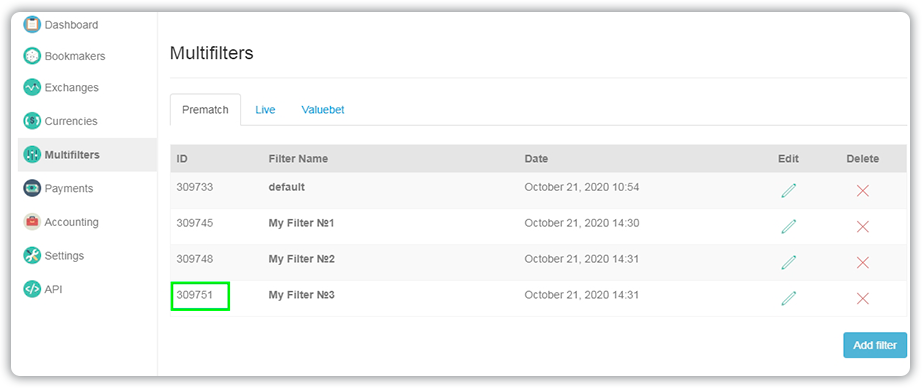
Web sandbox for debugging requests and filters. Before writing code, you can test any request directly in the browser through the interactive Swagger documentation with a "Try it out" feature. This significantly accelerates development and reduces the risk of errors at the start of integration.
The process of connecting to BetBurger API is transparent and well-documented.
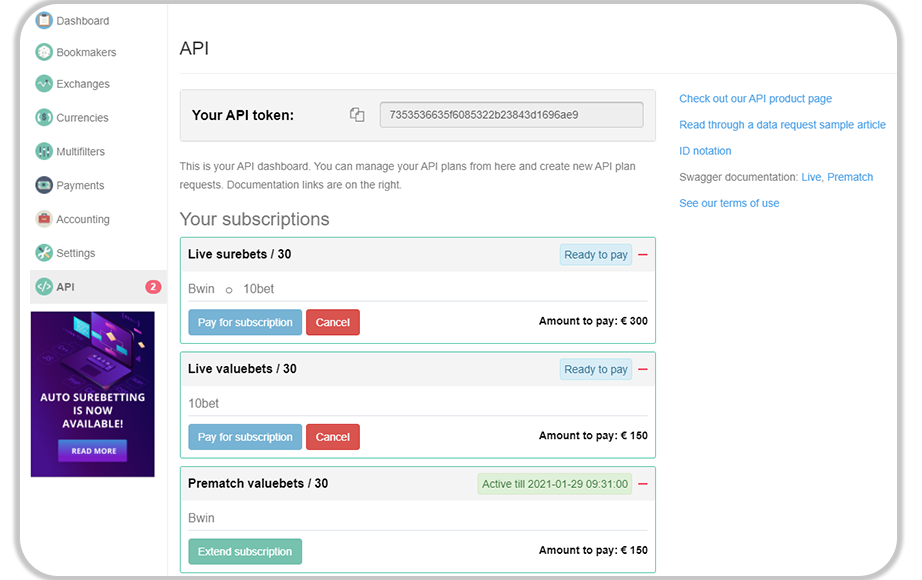
Access request and private API token. Access is provided upon request through the personal account. After approval, you receive a private token used to authorize all requests. An important nuance: the token updates with each new session, which must be accounted for when setting up automated systems and bots — token refresh logic should be built into the code in advance.
Two REST endpoints: live and prematch. The streams are separated: rest-api-lv.betburger.com for live situations and rest-api-pr.betburger.com for prematch. This separation allows independently scaling the processing of each data type.
Swagger documentation and "Try it out" for request generation. Full documentation is available at both endpoint addresses. The Swagger interface allows forming requests with needed parameters directly in the browser, viewing the response structure and immediately copying a ready curl request for integration.
Filtering in BetBurger API is one of the service's strong points. Request parameters allow specifying:
This combination of parameters allows receiving precisely the data stream your system needs, without excessive noise.
Selecting bookmakers and feed types when submitting a request. The API access application specifies particular bookmakers (up to 10 within one subscription) and feed types — prematch, live, surebets, valuebets. This means that before submitting the application, you should clearly define which bookmakers and data formats you plan to work with.
Application statuses. The activation process goes through several stages: application received → under review → ready for payment → subscription active → expired. Understanding this cycle helps plan the integration launch without unexpected delays.
Token refresh. As already mentioned, the token updates with each new session. For systems operating continuously, it's necessary to implement automatic token re-acquisition logic upon invalidation — otherwise the bot will stop upon restart or session break.
Can the API be used without automated betting (alerts only)?
Yes. Many use it only for alerts: process odds, trigger Telegram/email/webhook notifications, and decide manually. Great for early stages before full execution automation.
What matters more for surebets: bookmaker coverage or update frequency?
Both. Coverage finds more opportunities; speed determines if you catch them. Prematch: coverage matters more. Live: speed matters more. Best setups (incl. BetBurger) deliver both.
What matters more for valuebets: model/reference or "raw" odds?
Reference line matters most. Raw odds alone don’t show value without a benchmark. BetBurger uses sharp-bookmaker reference data to calculate valuebets and improve signal quality.
Who is BetBurger API best suited for?
Developers, arbitrageurs scaling beyond manual work, and pro teams/syndicates building high-throughput systems. Strong coverage, speed, filtering, and documentation make it a balanced choice.
 2
2
 0
0